

Russia’s war on Ukraine has had disastrous consequences for people in Ukraine, leaving over 16,295 civilian casualties, 6,430 killed and close to 7.8 million refugees across Europe as of October 2022. The impact of this war is not in isolation. Ripple effects are being felt globally, with increasing pressure on the global trade market, food availability and affordability.
Disruption to Global Exports
Russia and Ukraine are among the world’s largest exporters of wheat, cereals, vegetable oils and fertilisers. The war has disrupted this trade flow, affecting countries that rely heavily on these exports. In 2016-2021, 90% of Ukraine’s exports went to Africa and Asia, an important source of food for some of the most disadvantaged regions. Many of these countries are already struggling with internal conflicts and precarious food security situations.
At the start of the war, Russia blocked Ukraine’s ports, holding 20 million tonnes of grain on the Black Sea shores. As part of the Black Sea Grain Initiative, Russia agreed to stop the blockade in July 2022. As of November 2022, these shipments have recommenced, which has helped to reduce the high food prices. However, shipments are still about 40-50% below pre-war levels.
Increased Fuel and Food Prices
The disruption to trade flow is driving up the costs of food, fuel and fertiliser. Russia is one of the largest exporters of fertiliser. As a result of the disruption, fertiliser prices are at record high levels. The skyrocketing prices are significantly affecting other country’s ability to grow food, the effects of which will be seen well into 2023.
In 2021, Ukrainian farmers sowed almost 17 million hectares of crops. In 2022, they sowed 22% less. As a result, the production and export of Ukrainian crops is expected to decline, so It’s likely that this disruption will continue to be felt in years to come.
Countries that rely heavily on these imports will be among those most affected by the increase in prices. According to the International Food Policy Research Institute, this is primarily the Middle East and Africa.
Countries in Europe are currently not at risk of food shortages. However, food affordability remains a concern. Low-income groups are most affected by the increases in food costs.
Does this affect Australia?
Looking closer to home in Australia, we also won’t be at risk of major food shortages. Australia agricultural exports are in a favourable position, benefiting from higher global demand and prices. However, the impact will be seen with significant increases in energy prices. Consumers will feel this impact with higher petrol prices and an indirect impact on other goods and services due to higher higher transport costs. Knock-on effects from the war in Ukraine and COVID-19 are also pushing inflation up in Australia, with prices being passed on to consumers.
As shown below, global food prices have reached their highest level on record.
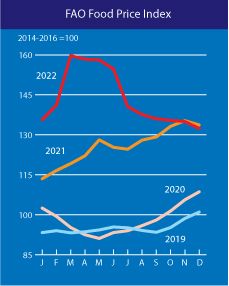
Source: fao.org
A Global Hunger Crisis in The Horn of Africa and Surrounding Regions
Ongoing conflict, changes in climate and the COVID-19 pandemic has triggered a global hunger crisis, driving millions into extreme hunger and malnutrition. According to WHO, over 80 million people across the greater Horn of Africa are currently facing food insecurity.
The decreased availability and affordability of food has had an immediate impact on dependent countries. Countries in East Africa, including Somalia, Ethiopia and Kenya source up to 90% of their wheat imports from Russia and Ukraine. Faced with extreme droughts, these are among some of the most heavily impacted areas. Children are among the most affected, with the UN estimating that 350,000 children in the Horn of Africa will die from hunger this year.
How You Can Help
The best way to help is to donate to one of the Emergency Action Alliance members responding to the emergency.
To learn more about the current situation, visit our hunger crisis information page or contact us online.


