
Whistleblower Policy
1. Introduction
1.1 Emergency Action Alliance (EAA) is committed to fostering a culture of legal, ethical and moral behaviour and exemplary corporate governance.
1.2 EAA recognises the value of transparency and accountability in its administrative and management practices, and supports the reporting of improper conduct.
1.3 This Whistleblower Policy and Procedure has been developed so that people can raise concerns regarding situations where they believe that EAA or anybody connected with EAA has acted in a way that constitutes serious wrongdoing, including unethical, illegal, corrupt or other inappropriate conduct, as set out below.
2. Purpose
2.1 This Policy aims to:
- encourage a person to report improper conduct in good faith if they know or have reasonable grounds to suspect such conduct
- provide a mechanism to report misconduct or dishonest or illegal activity that has occurred or is suspected within the organisation
- enable EAA to deal with reports from whistleblowers in a way that will protect the identity of the whistleblower and provide for secure storage of the information
- ensure that any Reportable Conduct is identified and dealt with appropriately
- ensure that individuals who disclose wrongdoing can do so safely, securely and with confidence that they will be protected and supported, and
- help to ensure that EAA maintains the highest standards of ethical behaviour and integrity.
3. Scope
3.1 This policy applies to:
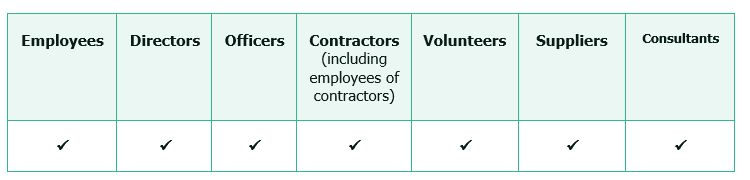
Within this policy all of these people are represented by the term “Workers”.
3.2 Although they are under no obligation to do so, any associate, family member or dependant of any person in the above groups of people may also speak up. If they do choose to speak up in line with this Policy, we will extend to them the relevant rights and protections under this Policy.
4. Principles
4.1 Higher standard – This Policy is designed to comply with EAA’s legal obligations. If anything in this Policy is inconsistent with any law imposed on EAA, that legal obligation or the “higher standard” will prevail over this Policy.
4.2 Speak up and report it! – We encourage Workers at EAA to report any concerns in line with our policies and procedures.
4.3 Our expectations of Workers – EAA expects Workers to act honestly and ethically, and to make any report on reasonable grounds.
4.4 Our responsibility to Whistleblowers – Our obligations to Workers are spelled out in this policy, but in particular in section 6 ‘Protection’.
4.5 Confidentiality and consent – EAA will maintain confidentiality of all reports and protect the identity of reporters to the fullest extent possible. While EAA encourages Whistleblowers to identify yourself to the preferred reporting channel (e.g.Whistleblower@emergencyaction.org.au) you may opt to report your concerns anonymously.
5. Reportable Conduct
5.1 Who can make a report?
5.1.1 A Whistleblower is a person who, whether anonymously or not, attempts to report misconduct or dishonest or illegal activity that has occurred in connection with EAA, and wishes to avail themselves of protection against reprisal for having made the report.
5.1.2 A Whistleblower may be a current or former Worker with EAA.
5.2 What is Reportable Conduct?
5.2.1 A person may disclose any information that the person has reasonable grounds to suspect misconduct, or an improper state of affairs or circumstances in relation to:
- EAA; or
- A related body corporate of EAA
5.2.2 Reportable Conduct is any past, present or likely future activity, behaviour or state of affairs considered to be:
- dishonest;
- corrupt (including soliciting, accepting or offering a bribe, or facilitating payments or other such benefits);
- fraudulent;
- illegal (including theft, drug sale or use, violence or threatened violence, or property damage);
- in breach of regulation, internal policy or code (such as our Code of Conduct);
- improper conduct relating to accounting, internal controls, compliance, actuarial, audit or other matters of concern to the whistleblower;
- a serious impropriety or an improper state of affairs or circumstances;
- endangering health or safety;
- damaging or substantially risking damage to the environment;
- a serious mismanagement of EAA’s resources;
- detrimental to EAA’s financial position or reputation;
- maladministration (an act or omission of a serious nature that is negligent, unjust, oppressive, discriminatory or is based on improper motives);
- concealing reportable conduct.
5.2.3 Reportable Conduct usually relates to the conduct of employees or directors, but it can also relate to the actions of a third party, such as a funder, supplier or service provider.
5.3 What is not Reportable Conduct?
5.3.1 While everybody is encouraged to speak up and report any concerns to EAA, not all types of conduct are intended to be covered by this Policy or by the protections under the Corporations Act 2001 (Cth). This Policy does not apply to personal work-related grievances (see 5.3.2, 5.3.3 and 5.3.4), unless the grievance includes victimisation due to whistleblowing. Those matters are dealt with under other policies.
5.3.2 Personal work-related grievances are those that relate to the discloser’s current or former employment with EAA that might have implications for the discloser personally but do not:
- Have any other significant implications for EAA (or another entity); or
- Relate to any conduct or alleged conduct about a disclosable matter (as set out in 5.2.2).
5.3.3 Personal work-related grievances include grievances such as interpersonal conflicts, decisions about promotions, decisions that do not involve a breach of workplace laws, or terms and conditions of employment.
5.3.4 However, personal work-related grievances may be covered by this policy where they include information about misconduct, an allegation that the entity has breached employment or other laws punishable by imprisonment by a period of 12 months or more, or the grievance includes victimisation due to whistleblowing.
5.4 What information do I need to make a report?
5.4.1 To make a protected report you must know of or have reasonable grounds to suspect the Reportable Conduct.
5.4.2 For a report to be investigated, it must contain enough information to form a reasonable basis for investigation. It is important therefore that you provide as much information as possible. This includes any known details about the events underlying the report such as the:
- date;
- time;
- location;
- name of person(s) involved
- possible witnesses to the events; and
- evidence of the events (e.g. documents, emails).
5.4.3 In your report, include any steps you may have already taken to report the matter elsewhere or to resolve the concern.
5.5 How can I make a report?
5.5.1 A report must be made to:
- Company Secretary or the Board Chair;
5.5.2 EAA will also protect individuals who have made a report in connection with EAA:
- To the Australian Securities and Investments Commission (ASIC) or the Australian Prudential Regulation Authority (APRA) or another Commonwealth regulatory body such as the Australian Charities and Non Profits Commissioner (ACNC)
- To a legal practitioner for the purposes of obtaining legal advice or legal representation about whistleblower protections; or
- That qualifies as an emergency or public interest disclosure under the Corporations Act 2001(Cth). It is important that you understand the criteria for making a public interest or emergency disclosure and you may wish to consult an independent legal adviser before making a public interest or emergency disclosure.
5.5.3 EAA encourages you to identify yourself to the preferred reporting channel whistleblower@emergencyaction.org.au, you may opt to report your concerns anonymously such as by adopting a pseudonym.
6. Protection
6.1 How will I be protected if I speak up about Reportable Conduct?
6.1.1 If you have reasonable grounds to suspect Reportable Conduct, even if it turns out your concerns are mistaken, EAA will support and protect you and anyone else assisting in the investigation.
6.1.2 EAA will not tolerate any detriment inflicted on you because you or somebody else has made, or might make, a report of Reportable Conduct. Examples of a detriment include:
- retaliation, dismissal, suspension, demotion, or termination of your role;
- bullying, harassment, threats or intimidation;
- discrimination, subject to current or future bias, or derogatory treatment;
- harm or injury;
- damage or threats to your property, business, financial position or reputation; or
- revealing your identity as a Whistleblower without your consent or contrary to law;
- threatening to carry out any of the above actions.
6.1.3 This protection applies regardless of whether any concerns raised in a report are found to be true, provided that you are acting honestly and ethically and made the report on reasonable grounds.
6.1.4 This protection also applies to individuals conducting, assisting or participating in an investigation. You will also be entitled to the protection if you make a report of Reportable Conduct to an external body under this Policy.
6.1.5 Anyone found to be victimising or disadvantaging another individual for making a disclosure under this Policy will be disciplined and may be dismissed or subject to criminal or civil penalties.
6.1.6 If you believe you have suffered a detriment in violation of this Policy, we encourage you to report this immediately to whistleblower@emergencyaction.org.au or companysecretary@emergencyaction.org.au, or an external body under this Policy. Your concerns of being disadvantaged will be treated as a report of Reportable Conduct in line with this Policy.
6.1.7 Anyone engaging in detrimental conduct may be subject to serious consequences, including disciplinary action and/or termination of engagements or contracts, as applicable. They may also be subject to civil and criminal penalties.
6.1.8 You may also be entitled to the following legal protections for making a report:
- protection from civil, criminal or administrative legal action;
- protection from having to give evidence in legal proceedings; and/or
- compensation or other legal remedy.
6.2 How will EAA ensure confidentiality?
6.2.1 A discloser can choose to remain anonymous while making a disclosure, over the course of the investigation and after the investigation is finalised. EAA will do all it can to protect confidentiality.
6.2.2 However, we encourage all individuals to disclose their identity when raising a concern. This will assist us to gather further information on your report. If you choose to disclose your identity, your details will be treated confidentially to the fullest extent possible in connection with the investigation. EAA will take measures to protect your identity such as by redacting your personal information, storing your information and disclosure securely, referring to you in a gender-neutral context and only allowing qualified staff to investigate your disclosures.
6.2.3 You may choose to report your concerns anonymously. However, if you choose to disclose your identity, your details will be treated confidentially to the fullest extent possible in connection with the investigation, and your identity will not be disclosed unless:
- you consent in writing to the disclosure;
- the disclosure is made to ASIC, APRA, the Australian Federal Police (AFP);
- the disclosure is made to a Legal Practitioner for the purpose of obtaining advice;
- the disclosure is authorised under the Corporations Act 2001 (Cth); and/or
- disclosure is necessary to prevent or lessen a threat to a person’s health, safety or welfare.
6.2.4 We encourage all individuals to disclose their identity when raising a concern. This will assist us to gather further information on your report. All information relating to a report of Reportable Conductwill be stored securely and access will be limited to authorised staff.
6.2.5 It is illegal for a person to identify a discloser, or disclose information that is likely to lead to the identification of the discloser unless an exception above applies. If you feel that your confidentiality has been breached, you can lodge a complaint with a regulator, such as ASIC, APRA or the ATO, for investigation. EAA may also take disciplinary action against individuals that breach the confidentiality of a discloser, including summary dismissal.
6.3 False reports or disclosures
6.3.1 Protected Disclosures must be made on reasonable grounds. Anyone who knowingly makes a false report/disclosure of Reportable Conduct may be subject to disciplinary action, including dismissal.
6.3.2 The disciplinary action will depend on the severity, nature and circumstance of the false disclosure.
7. Handling and investigating a disclosure
7.1 Upon receiving a Protected Disclosure, within 10 days, EAA will endeavour to assess the disclosure to determine whether:
- It qualifies for protection; and
- A formal, in-depth investigation is required.
7.2 EAA will endeavour provide the discloser with regular updates.
7.3 EAA may not be able to investigate a disclosure if it is unable to contact the discloser.
7.4 EAA will handle and investigate Protected Disclosures in accordance with the Whistleblowing Procedure below.
8. Monitoring and assurance
8.1 This Policy will be distributed and available to all Workers via EAA’s intranet and onboarding materials.
9. Related Documents
9.1 Whistleblowing Procedure
9.2 EAA’s Code of conduct
10. Legislation & Industrial Instruments
- Corporations Act 2001 (Cth)
- Fair Work Act 2009 (Cth)
- Fair Work Regulations 2009 (Cth)
- Insurance Act 1973
- Life Insurance Act 1995
- Public Interest Disclosure Act 2013
- Superannuation Industry (Supervision) Act 1993
- Corporations Act 2001 (Cth)
- Fair Work Act 2009 (Cth)
- Fair Work Regulations 2009 (Cth)
- Insurance Act 1973
- Life Insurance Act 1995
- Public Interest Disclosure Act 2013
- Superannuation Industry (Supervision) Act 1993
- Taxation Administration Act 1953
This policy & procedure is not intended to override any industrial instrument, contract, award or legislation.
Annex 1: Responsibilities
1.1 The Whistleblower Program Team (WP Team), comprised of the Chair of the Board, Company Secretary and Responding Manager, is responsible for:
- Assisting the Responding Manager in the assessment and oversight of whistleblower reports
- Providing advice and support to reporters
- Maintaining a secure and restricted record of all reports made under this Policy and Procedure
- Arranging role-specific training as and when required.
1.2 Responding Manager(s) are responsible for:
- Receiving whistleblower reports and protecting the interests of reporters
- Determining whether the report falls within the scope of the Policy
- Determining whether and how a report should be investigated
- Appointing a Whistleblowing Investigator where an investigation is deemed appropriate
- Ensuring investigations are conducted in accordance with this Policy
- Ensuring any reports involving a Board Director or the Project Director are reported to the Board Chair
- Updating reporters on progress and details of outcomes to the fullest extent possible
- Maintaining to the fullest extent possible confidentiality of the identity of and reports received by reporters
- Immediately reporting concerns in relation to any detrimental conduct to the Project Director or Board
- Chair (provided that the concerns do not relate to them)
- Determining the appropriate courses of action to remediate or act on the investigation
- Making recommendations to prevent future instances of reportable misconduct
- Completing any training mandated by the Executive Director.
- Seeking to ensure the integrity of the Whistleblower Program is maintained.
1.3 Whistleblower Investigators are responsible for:
- Investigating reports in accordance with this Policy and Procedure
- Maintaining to the fullest extent possible confidentiality of the identity of and reports received by reporters
- Gathering evidence and taking steps to protect or preserve evidence
- Making findings based on a fair and objective assessment of the evidence gathered during the investigation, and formalising this in a report
- Keeping comprehensive records about the investigation
- Making recommendations to the Whistleblowing Protection Officer about how to implement the strategy in relation to how reported misconduct can be stopped, prevented and/or mitigated in future
- Reporting back to the Responding Manager on the progress of their investigation 7 days after the report and every 14 days thereafter
- Complying with the directions of the Responding Manager in relation to any further follow up, and reporting action and requirements, including the implementation of any recommendations.
1.4 Workers are responsible for reporting misconduct or dishonest or illegal activity that has occurred or is suspected within EAA as quickly as possible, whether anonymously or otherwise.
Annex 2: Procedure
2.1 How do I make a report?
2.1.1 Whistleblowing protections will only apply to reports of Reportable Conduct made in accordance with this Policy and Procedure.
2.1.2 Where you have reasonable grounds to suspect that an individual has engaged in Reportable Conduct, you should report the matter to any person authorised by EAA to receive Whistleblower disclosures. Authorised people are:
- Executive Director
- Company Secretary
2.1.3 If you are not comfortable or able to report Reportable Conduct internally, you may report it to ASIC.
2.2 How are reports investigated?
2.2.1 After receiving your report EAA will:
- assess the report of Reportable Conduct;
- consider whether there are any conflicts of interest prior to investigating;
- determine whether external authorities need to be notified;
- determine whether and how to investigate; and
- appoint a Whistleblowing Investigator if appropriate.
2.2.2 If an investigation is deemed necessary, it will be conducted fairly, objectively and in a timely manner. The investigation process will vary depending on the nature of the Reportable Conduct and the amount of information provided.
2.2.3 Any individuals who are accused of misconduct in a report (a Respondent) will have an opportunity to respond to allegations before any adverse findings are made and before any disciplinary action (if appropriate) is taken.
2.2.4 EAA may need to speak with a Whistleblower as part of an investigation. If the identity of the Whistleblower is known, EAA will endeavour to keep them informed about the status of an investigation.
2.2.5 If there is insufficient information to warrant further investigation, or the initial investigation immediately identifies there is no case to answer, the individual who reported the Reportable Conduct will be notified at the earliest possible opportunity.
2.3 Outcome of an investigation
2.3.1 At the conclusion of the investigation, a report will be prepared outlining:
- a finding of all relevant facts;
- a determination as to whether the allegation(s) have been substantiated or otherwise;
- the action that will be taken, which may include disciplinary action and dismissal.
2.3.2 The disciplinary action will be dependent on the severity, nature and circumstances of the Reportable Conduct.
2.3.3 Where possible and appropriate, having regard to EAA privacy and confidentiality obligations, the Whistleblower will be informed of the outcome of any investigation into their concerns.
Annex 3: Procedure flow chart

Annex 4: The Emergency Action Alliance Safeguarding Concern Reporting Form
ALL INFORMATION IN THIS FORM WILL BE TREATED CONFIDENTIALLY
Personnel, Representatives and Partners must report any behaviour that is suspected of causing Harm and any instances of Policy non-compliance.

